

Let me take you back to a Tuesday morning in 2006. A frantic owner rushed into my clinic holding a magnificent, but highly stressed, adult Pogona vitticeps named "Rex." Rex’s claws had grown so long that they were physically twisting his toes sideways, causing early-stage joint distress and making it painful for him to walk. It took me 15 minutes to carefully clip his claws, meticulously avoiding the blood vessel, and another 20 minutes to calm the owner down.
Fast forward to today, twenty years into my career as an exotic animal veterinarian. While the tools of my trade have evolved, the physical anatomy of bearded dragon nails hasn't changed a bit. Yet, I still see variations of Rex's case in my clinic almost every week.
Overgrown claws are more than just a cosmetic issue; they are a severe health hazard. When a dragon's nails grow too long, it alters their natural gait. This unnatural walking posture can lead to toe deformities, torn ligaments, and even exacerbate metabolic bone disease.
In this comprehensive guide, I’m going to put on my stethoscope and teach you exactly how to safely trim your reptile's claws at home, minimizing stress for both you and your scaly friend.
Understanding the Anatomy of a Reptile Claw 🧱
Before we even pick up a pair of clippers, we need to understand what we are looking at. When I look at a reptile's foot, I see two distinct parts of the claw: the dead keratin and the living tissue.
Think of a bearded dragon's nail like a pencil. The wooden outer layer is the hard keratin sheath—this is the part we want to trim. The lead in the center of the pencil is what veterinarians call "the quick." The quick is a vital vascular structure packed with blood vessels and highly sensitive nerve endings. Cutting into the quick is incredibly painful for your dragon and will cause immediate bleeding. Our entire goal during a pedicure is to remove the sharp, overgrown keratin tip without ever touching the quick.
The Evolution of the Claw in Captivity
In the wild deserts and woodlands of Australia, a bearded dragon spends its days digging, climbing rough bark, and scurrying across hard, abrasive rocks. This constant friction acts as a natural nail file, keeping their claws perfectly blunted.
In captivity, however, dragons often live on softer substrates like paper towels, reptile carpet, or smooth vinyl flooring. Without that natural abrasion, the nails grow continuously, eventually curving under the foot. This is why manual trimming becomes an essential part of responsible reptile husbandry.
How to Trim Bearded Dragon Nails Safely: 7 Actionable Steps 🎯
Trimming your dragon's nails doesn't have to be a battle of wills. With the right preparation and technique, it can be a quick and painless process. Here is the exact protocol I teach my veterinary technicians.
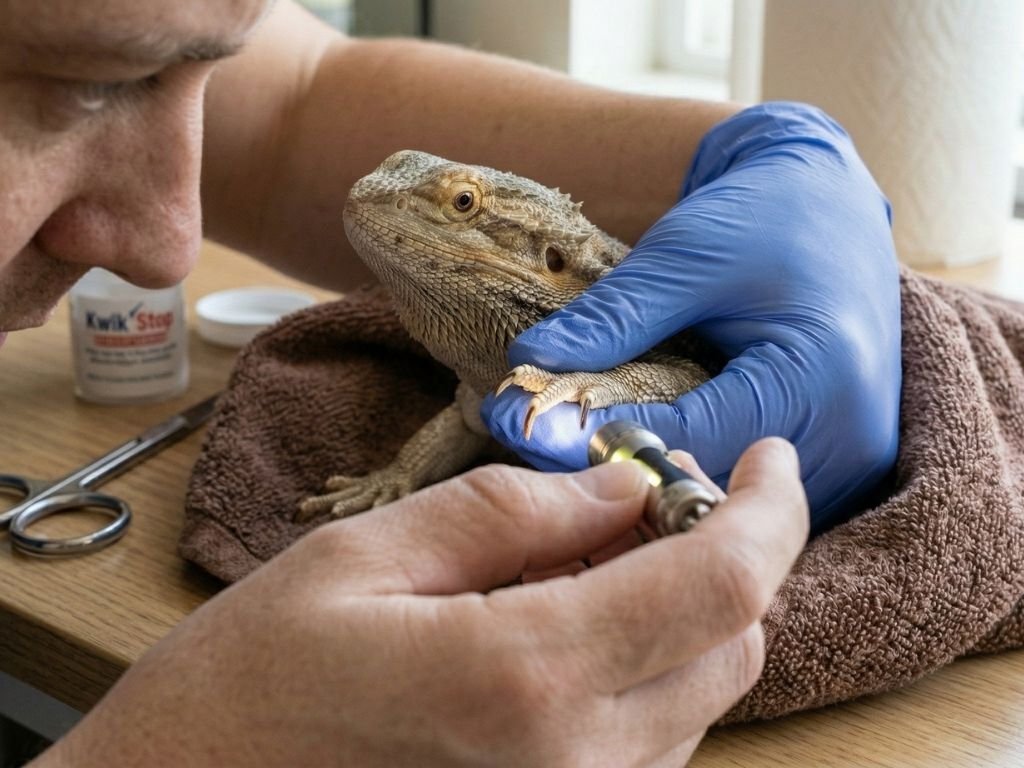
- 1. Gather your tools: You need small, scissor-style cat or reptile nail clippers. Avoid standard human nail clippers, as they tend to crush the rounded claw rather than cleanly slicing it. You also must have a small container of styptic powder (or cornstarch, in a pinch) nearby to stop any accidental bleeding.
- 2. Secure the dragon (The Burrito Method): Reptiles can be squirmy when they feel vulnerable. Wrap your bearded dragon gently but firmly in a small, soft towel, leaving only one leg exposed at a time. This "burrito method" keeps them feeling secure and prevents sudden jerking movements.
- 3. Identify the quick: Look closely at the nail under bright, direct lighting. You will see a thicker, darker base (where the blood vessel lives) and a thinner, often curved, translucent tip.
- 4. Position the clippers: Place the clippers only over the very tip of the translucent nail. I recommend leaving a buffer zone of at least two millimeters between your clipper blades and the dark quick.
- 5. Make a swift cut: Once you are confident in your placement, snip the tip quickly and cleanly. Hesitation can cause the nail to pinch, which is uncomfortable for the reptile and might make them pull away.
- 6. Apply styptic powder if needed: Even experts occasionally nip the quick. If the nail bleeds, do not panic. Immediately dip the bleeding claw into your styptic powder and apply gentle pressure for a few seconds until the bleeding stops completely.
- 7. Reward your reptile: Positive reinforcement works wonders. Immediately after the session, offer a high-value treat—like a juicy hornworm or a fresh piece of butternut squash—to create a positive association with grooming.
Frequently Asked Veterinary Questions
Over the years, I've heard every question imaginable regarding reptile grooming. Here are the most common concerns I address in the examination room:
How often should I trim my bearded dragon's nails? On average, you should trim your bearded dragon's nails every 4 to 6 weeks. However, this heavily depends on the texture of their enclosure substrate.
Do bearded dragon nails grow back? Yes, bearded dragon nails continuously grow throughout their entire lives. If a nail is completely ripped out by accident, it may grow back deformed, which is why keeping them trimmed prevents them from catching on hammock meshes or carpets.
Can I use a motorized nail grinder (like a Dremel) on my dragon? While some experienced keepers use them, I generally advise against it for beginners. The vibration can be highly distressing to small lizards, and it is very easy to accidentally grind down into the quick before you realize it. Stick to manual clippers.
What happens if an overgrown nail causes a toe to twist? If a toe is visibly twisted or swollen, do not attempt to fix it yourself. This could be a sign of a localized infection, a fracture, or metabolic bone disease. Seek professional veterinary care immediately.
A Tale of Two Dragons: Real-World Husbandry
To illustrate how much environment matters, let's look at two patients of mine.
Patient A: "Spike" Spike lived his first three years in an enclosure lined entirely with soft fleece reptile carpet. His owner brought him in because Spike had stopped hunting crickets. Upon examination, his nails were so long they had snagged on the carpet loops, causing two of his toes to sprain. We had to do a corrective trim, administer pain medication, and switch his substrate.
Patient B: "Lizzie" Lizzie is a five-year-old female whose owner built a custom enclosure featuring a large, natural slate basking platform and rough, textured climbing branches. In the three years I have been Lizzie's primary vet, I have never had to trim her nails. Her environment does 100% of the work for us.
The takeaway here is simple: if you want to minimize the amount of trimming you have to do, upgrade your dragon's furniture. Placing rough slate tiles directly under their basking light is one of the easiest ways to keep their claws naturally filed.
Conclusion + Final Tips
Trimming bearded dragon nails shouldn't be a source of anxiety. By understanding the physical anatomy of the claw and taking your time, you can easily master this essential aspect of reptile husbandry.
💡 Final Tips for Success:
- Always err on the side of caution. Trimming just a tiny sliver of the nail every few weeks is infinitely better than cutting too deep once.
- Never trim nails when your dragon is cold. Wait until they have been basking and are fully alert, as they will be more cooperative and less stressed.
- Make sure your enclosure has natural slate or textured rocks to do half the work for you.
If you are struggling with your reptile's husbandry, or you just want to make sure you aren't going to accidentally clip the quick on your first try, don't guess. Have your local exotic vet demonstrate the process for you in person.
Do you have more questions about bearded dragon care, diet, or lighting? Visit https://beardiepedia.com/contact/ to get in touch.
Stay safe, and happy keeping!
Dr. Lachlan Reed Exotic Animal Veterinarian
0 Comments