

When you bring a bearded dragon into your home, you aren't just becoming a pet owner; you are actively tasked with mimicking the sun.
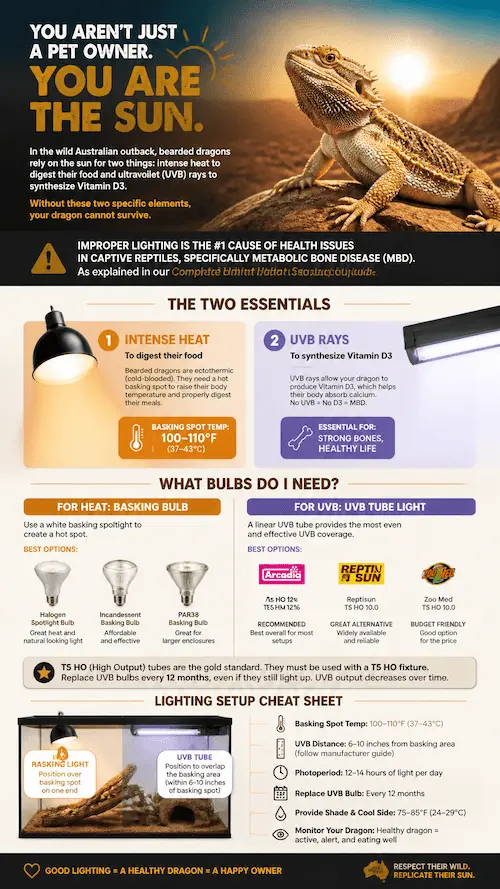
In the wild Australian outback, Pogona vitticeps relies entirely on solar radiation for survival. They require intense infrared heat to raise their core body temperatures and fuel their metabolism, alongside ultraviolet B (UVB) rays to synthesize Vitamin D3. Without these two environmental elements running in perfect harmony, a bearded dragon's body will rapidly deteriorate.
The sobering reality is that improper lighting and heating setup remains the number one cause of metabolic disease and systemic failure in captive reptiles.
When a dragon enters my examination room with advanced Metabolic Bone Disease (MBD) or profound lethargy, it is rarely due to a lack of love from the owner—it is almost always due to confusing, outdated, or outright misleading advice found on commercial pet store labels.
This guide strips away the marketing jargon and outlines the exact parameters required to keep your reptile thriving.
Part 1: Thermal Gradients and Basking Temperatures 🧱
Bearded dragons are ectothermic, meaning they cannot generate internal body heat. If their surrounding environment is too cold, their digestive tract shuts down. Food will literally sit in their stomach and rot, leading to systemic toxicity, severe gut impaction, and death.
To survive in an enclosure, your dragon requires a temperature gradient—a distinct hot side and cool side. This allows them to self-regulate their internal temperature by moving back and forth between the zones.
Core Enclosure Temperature Parameters
| Zone | Target Surface Temperature | Target Ambient Temperature | Clinical Purpose |
|---|---|---|---|
| Basking Spot | 100°F – 110°F (38°C – 43°C) | 90°F – 95°F (32°C – 35°C) | Triggers enzymatic digestion and metabolic activity. |
| Cool Side | N/A (Surface) | 75°F – 85°F (24°C – 29°C) | Prevents thermal stress and allows cooling. |
| Nighttime | N/A (Surface) | 65°F – 75°F (18°C – 24°C) | Mimics natural desert drops; boosts immune health. |
Note for Juveniles: Baby dragons (0–12 months) have a much faster metabolism and smaller body mass. They require a tighter basking surface temperature closer to 107°F – 110°F to digest their heavy insect diets safely. Adults are perfectly content with a surface temp around 100°F – 105°F.
Choosing the Correct Heat Bulb
You do not need to buy overpriced, heavily marketed "specialty reptile" basking bulbs. In my clinic, I actively steer owners toward standard halogen floodlights (specifically PAR38 or PAR30 bulbs) from your local hardware store. Halogen elements emit a wide, rich spectrum of Infrared-A and Infrared-B radiation, which penetrates deep into the muscle tissue.
- Avoid Spot Lamps: Never buy tight "spot" bulbs. They focus a narrow, laser-like beam of heat that can easily burn a dragon's dorsal scales while leaving the rest of their body freezing cold.
- The Vet's Tool Tip: Throw away those stick-on analog dial thermometers sold at pet stores. They are notoriously inaccurate, often misreading temperatures by up to 15°F. Instead, invest in a Digital Laser Infrared Thermometer (Temp Gun). Pointing a laser directly at the basking rock gives you the true surface temperature in real-time.
Enclosure Warning: Achieving a functional thermal gradient is physically impossible in small enclosures. If your tank is too small, the heat bulb will turn the entire habitat into an oven. This is the primary reason why we require a minimum 120-gallon enclosure in our complete guide on Bearded Dragon Tank Size Requirements.
Part 2: Linear UVB Lighting (The Critical System)
While heat fuels digestion, UVB light fuels bone formation. UVB radiation is completely invisible to human eyes, but for a bearded dragon, it is the catalyst that allows them to absorb calcium.
When high-output UVB hits a reptile's skin, it converts cholesterol into Vitamin D3. Without D3, their intestines cannot absorb a single milligram of the calcium you dust onto their insects. The body will then begin pulling calcium directly from their skeleton to keep their heart beating, resulting in tragic bone deformities, jaw softening, and tremors.
Furthermore, glass and heavy plastic completely filter out 100% of UVB rays. Placing a terrarium next to a bright window does absolutely nothing for your pet's skeletal health.
Tube Bulbs vs. Compact Coils
- ❌ Coil / Compact Bulbs (The Danger): These look like spiraled energy-saving bulbs and screw into standard dome fixtures. Do not use them. They project UVB in a narrow, highly concentrated cone. If your dragon sits slightly outside this cone, they receive zero UV radiation; if they sit too close, it can cause severe corneal damage.
- ✅ Linear Tube Bulbs (The Gold Standard): These long fluorescent tubes span across the top of the enclosure, creating an even "sunline." They ensure your dragon receives adequate UV exposure whether they are basking, climbing, or resting.
The Professional Recommendation
You need a T5 High Output (HO) linear fixture. The two most reliable, clinically proven bulbs on the market are:
- Arcadia T5 HO 12% Desert
- Zoo Med ReptiSun 10.0 T5 HO
The fixture should cover roughly 1/2 to 2/3 of your enclosure's total length and must overlap directly with the heat lamp. This creates a unified "basking zone" where the dragon can soak up both heat and UV rays simultaneously, just like they would in nature. Remember to replace these tubes every 12 months—even if the bulb is still shining light, the invisible gas inside degrades, and the UV output drops to zero.
Part 3: The Nighttime Breakdown and the "Red Light" Myth 🎯
Walk into almost any commercial pet store, and an employee will likely try to sell you a "Nighttime Red Heat Bulb," claiming reptiles cannot see red light. This is an absolute myth that causes significant harm.
Bearded dragons have highly advanced tetrachromatic vision. They can see red light perfectly clear. Leaving a colored bulb on all night completely destroys their circadian rhythm, leading to chronic sleep deprivation, profound psychological stress, and a suppressed immune system.
- At Night, Keep It Pitch Black: Your enclosure lights must turn completely off. A healthy night drop down to 65°F (18°C) is completely natural and beneficial for their respiratory health.
- If Your House Drops Below 65°F: Do not use light. Instead, install a Ceramic Heat Emitter (CHE). This is a solid ceramic element that screws into a ceramic dome socket and emits pure, radiant infrared heat with zero visible light.
Implementing an Automated Lighting Schedule
Consistency is paramount. If your lighting schedule is erratic, your dragon’s internal clock will shatter, leading to loss of appetite and behavioral shutdowns. Use a digital wall timer to automate the cycle:
- Summer Cycle: 14 hours on / 10 hours off.
- Winter Cycle: 12 hours on / 12 hours off (or 10 on / 14 off if you are safely inducing brumation).
If you notice your dragon slowing down or showing signs of seasonal changes despite your automated schedule, read our comprehensive guide on 7 Signs Your Bearded Dragon Is Sick to rule out underlying clinical conditions.
Summary Setup Checklist
Before you introduce your dragon to their enclosure, ensure your lighting array features:
- [ ] A white Halogen Floodlight (PAR38) adjusted to a surface temperature of 100°F – 110°F.
- [ ] A T5 HO Linear UVB Tube (Arcadia 12% or ReptiSun 10.0) spanning 2/3 of the tank.
- [ ] A digital infrared laser temp gun for daily parameter checks.
- [ ] An automated digital timer set to a consistent day/night cycle.
- [ ] A Ceramic Heat Emitter (only if nighttime ambient temps drop below 65°F).
Frequently Asked Questions About Bearded Dragon Lighting
Can bearded dragons see red nighttime lights?
Yes, bearded dragons see red light very clearly. Leaving a red heat lamp on at night disrupts their natural sleep cycles, leading to systemic stress, lethargy, and an impaired immune system.
How often should I replace my bearded dragon's UVB tube?
Linear T5 HO UVB tubes must be replaced every 12 months. Even though the bulb will continue to emit visible light, the internal phosphors degrade over time, causing the invisible UV output to drop below therapeutic levels.
What should the surface temperature of the basking spot be?
The ideal surface temperature for an adult basking spot is between 100°F and 105°F (38°C – 40°C). Baby and juvenile dragons require a hotter basking surface between 107°F and 110°F (41°C – 43°C) to facilitate proper digestion.
Why can't I use a regular window for UVB exposure?
Standard window glass filters out nearly 100% of solar UVB radiation. Relying on sunlight through a window pane will cause your bearded dragon to develop severe calcium deficiencies and Metabolic Bone Disease.
Once your thermal gradients are locked in and your UV lines are safe, the next critical step is ensuring your terrarium floor won't cause systemic blockages. Read our clinical review of Safe vs. Dangerous Substrates to protect your reptile from impaction risks.
0 Comments